
LONDON HAS FALLEN (AGAIN)
WHY THE RIGHT-WING ARE LOSING THEIR MINDS OVER TRAIN GRAFFITI
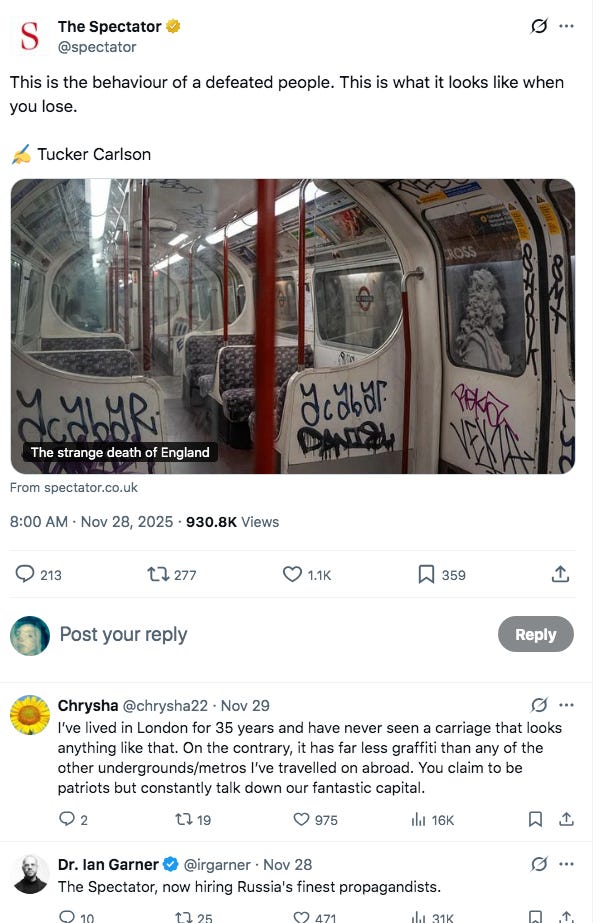
Back in November The Spectator, featured a rant, from American professional opinion-grifter, Tucker Carlson declaring the “Strange Death Of England”. Carlson cites, as many have done before him, graffiti on the underground trains as a signifier of general cultural decline. In this case he takes it over the edge; fearing an inevitable social collapse. It is a short step from the criminal underworld of a film like Warriors to a full blown Escape From New York post apocalypse of constantly burning cars, mutant zombies and nuclear winter. But why are graffiti writers always tagged with the blame for the spread of urban crime and social discord?
Other publications must carry some of the blame, Zoe Strimpel’s article in The Telegraph leads with this criminally loaded headline: London’s graffiti-riddled corpse is a warning of our apocalyptic future. It has everything: a gunshot metaphor linking graffiti directly to violent activity, implying gang involvement, and the doom-saying of The Telegraph’s right-wing cohort, which will always lean on the protection of private and public property above all else, a classic conservative trope.
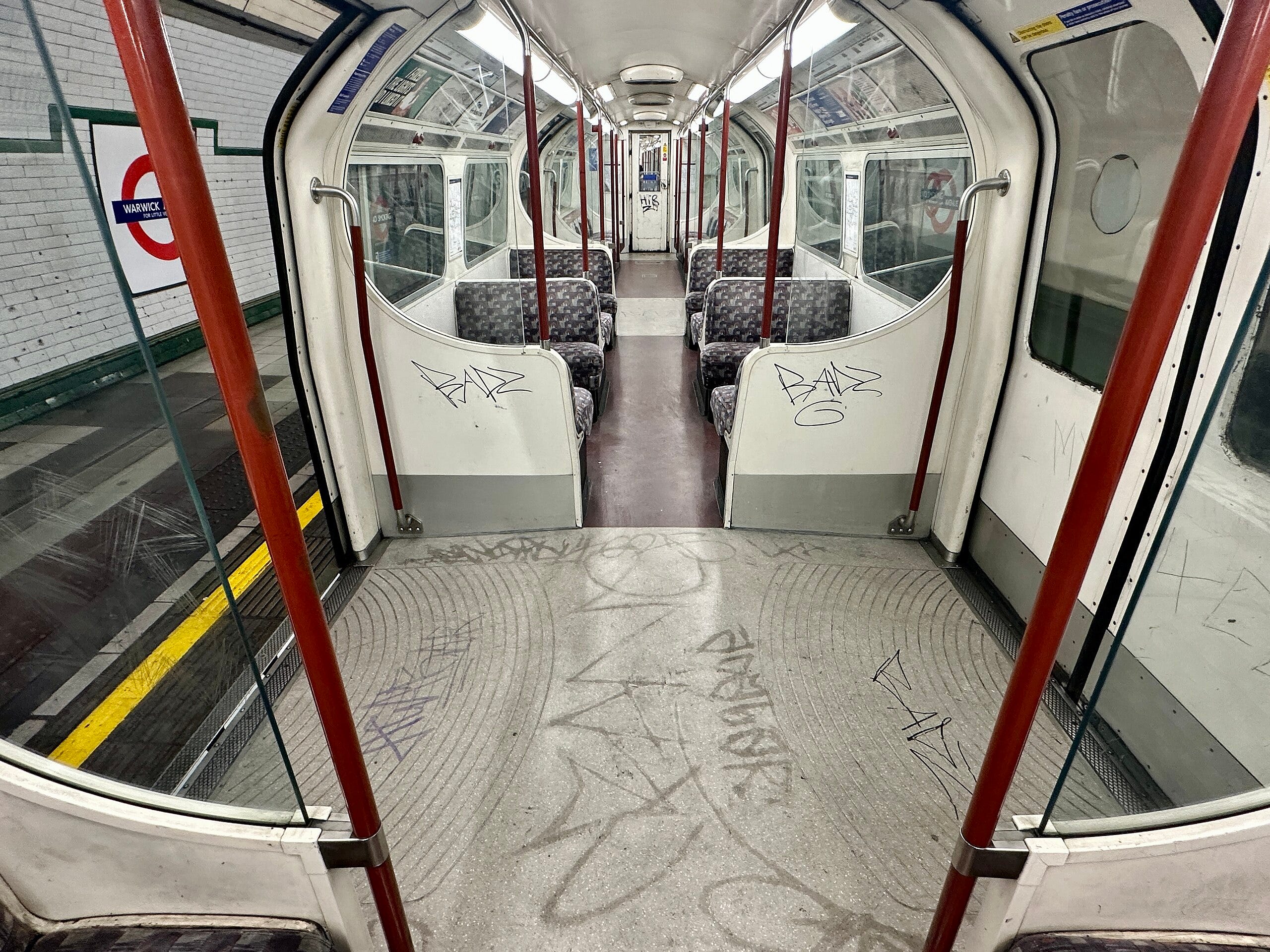
The image which heads Carlson’s article–Graffiti on the Bakerloo Line Credit: Carl Court/Getty Images–has been recycled by untold publications, mostly in relation to the spread of graffiti across TFL lines. It stands alongside a blizzard of factoids scraped together from AI overviews by eager beaver journos since July 2025 and through to the rest of the year as the story rolled on: Transport for London (TfL) says it is removing about 3,000 pieces of graffiti each week on the Central and Bakerloo Tube lines, it costs £11m per year to clean-up this graffiti, and in spire of this TFL have halved the number of cleaning shifts working on the trains. In this context, the image is actually quite misleading, Carlson, who clearly writes with his elbows, only mentions graffiti the once, admits London is “quite nice” he also refers to Native Americans, ‘the trenches’, abortion and continually punctuates his bluster with the rhetorical outburst—“What is that?” One can only guess.
The Spectator used to be a magazine. Now it is better known for its outlandish, click-bait ‘journalism’ which persists through ‘edgy’ dad-humour click-bait editorials (its literary coverage is actually very good). These they feature such golden insights as arguing that David Bowie is objectively overrated, an op-ed from Bonnie Blue declaring her support for the Reform party, and trying to predict the next holiday season terrorist attack with all the subtlety of Paddy Power…peerless stuff. But even The Spectator distanced themselves from Carlson’s premature outbursts, discreetly terming his piece a ‘monologue’.
WHERE HAVE ALL THE BAD GUYS GONE?
David Aaronivitch, alongside many other prominent journalists living in London, promptly took to Twitter to disagree – stating that he had never seen this same level of tagging, graffiti or vandalism on TFL trains.
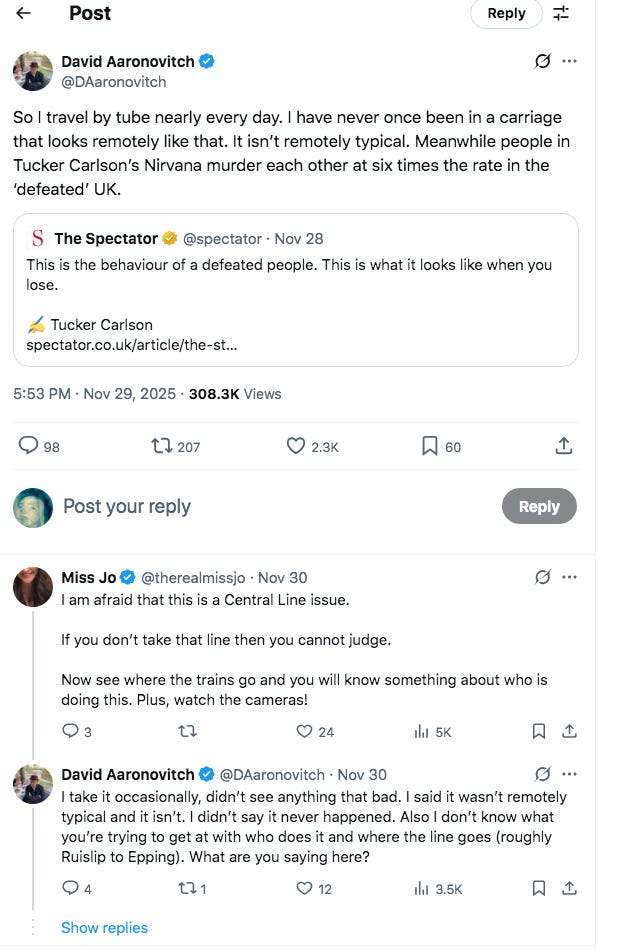
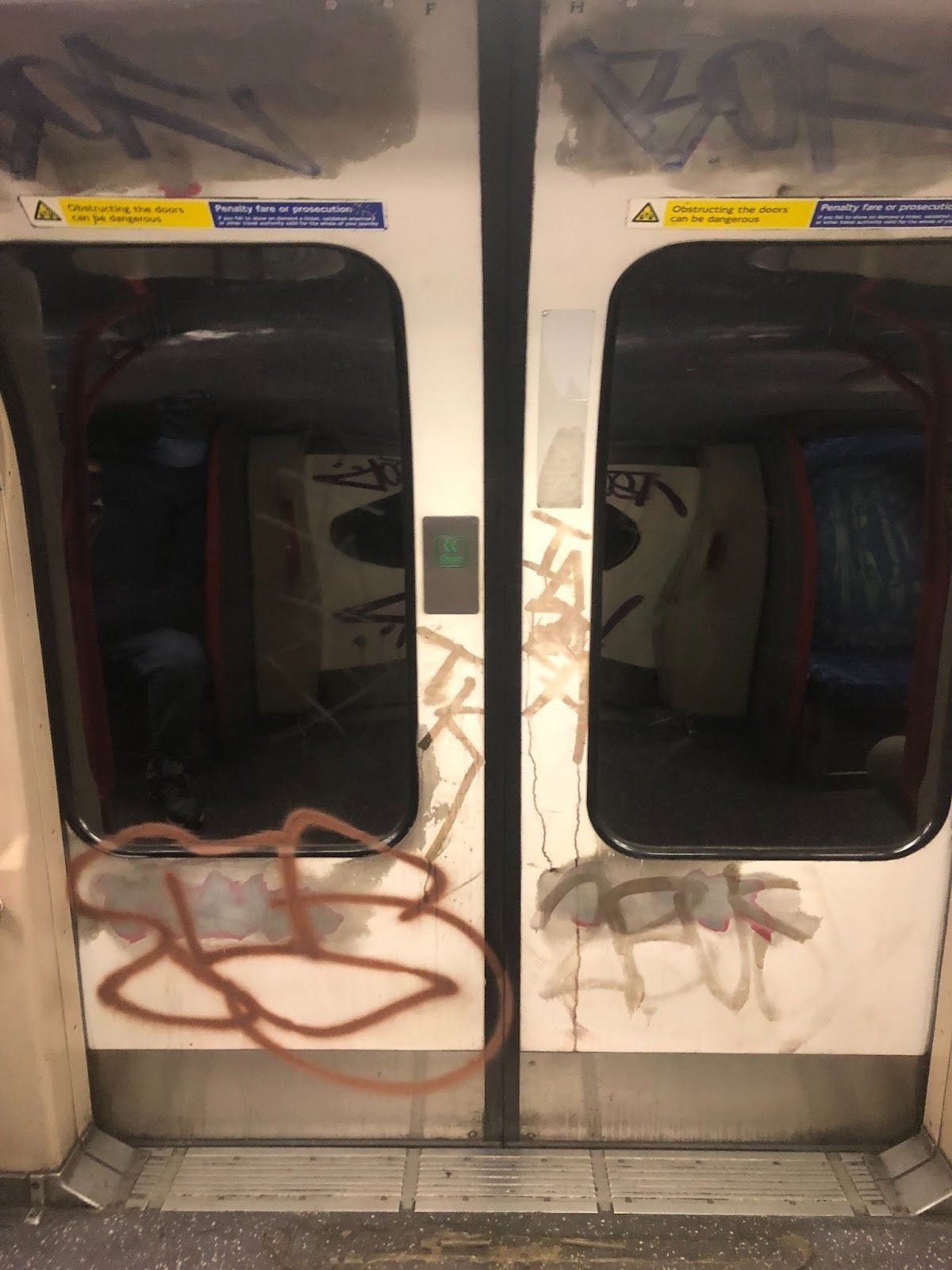
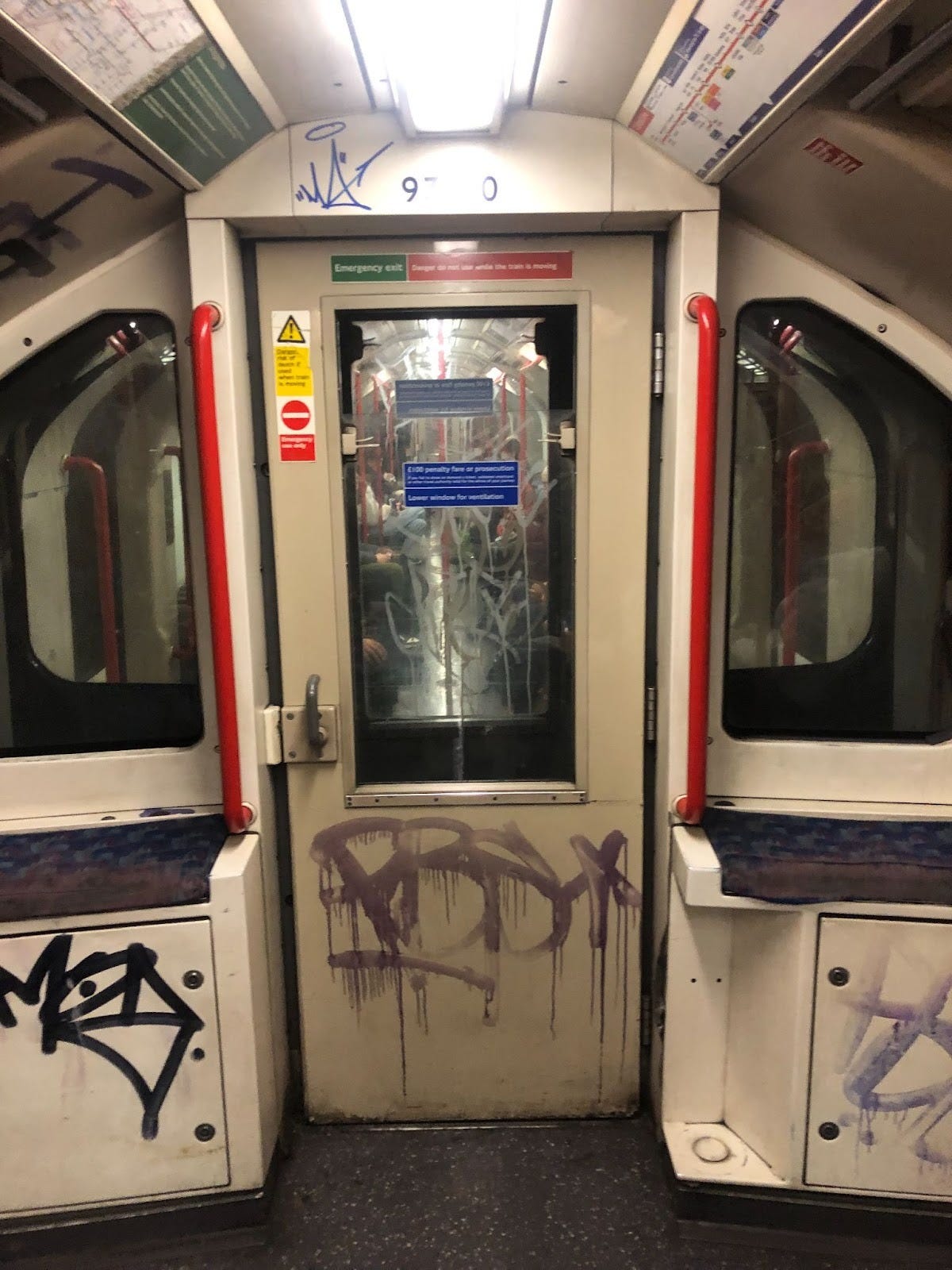
His post met with mixed responses, I marked around a 50/50 split between those who disagreed with Aaronivitch, citing the grim state of trains on the Bakerloo and Central lines as often being vandalised in some way: windows marked by key or acid scratches, torn or stained seat covers and lots of tags with permanent marker pens or spray cans. Others chimed in stating they had never seen a train the way it was pictured by Carlson, effectively calling him out to be untruthful, and that the images he posted might even be fake.
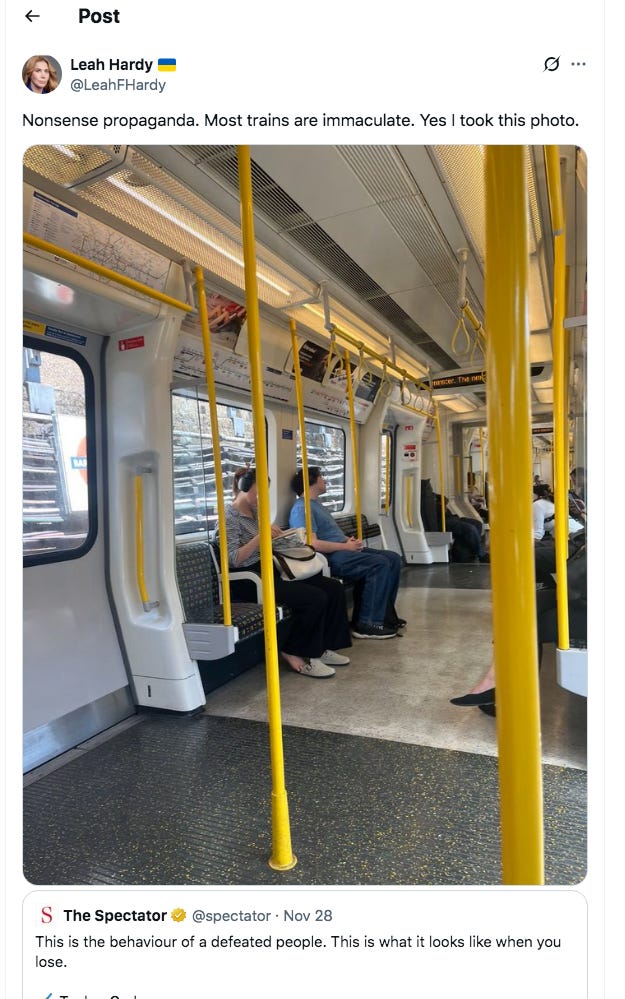
If anything these sharply divided remarks are simple proof that you can live in a massive metropolis without knowing everything that is going on, particularly on train lines you might never take. But nonetheless, people were keen to argue the toss, suitably triggered by Carlson’s shoddy ‘journalism’.
Accordingly, I went to check it out for myself, indeed hopping off at dear old Mile End station after a short ride on the Central Line, I already had several shots from a couple of carriages pretty heavily tagged.
WE CLEAN YOUR TRAINS 4 FREE
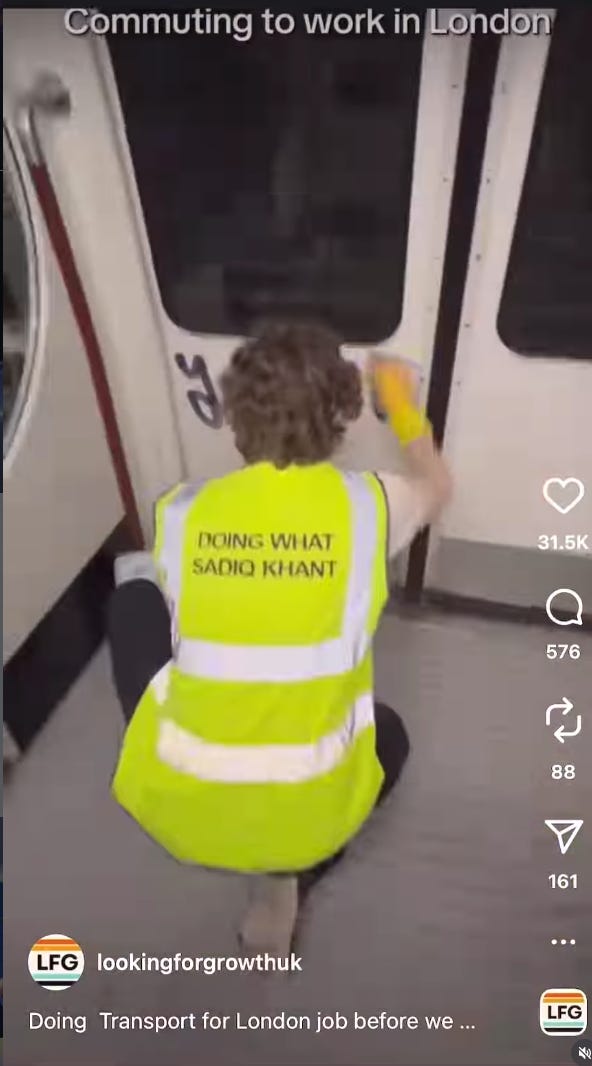
New tension behind this debate started back in July of 2025 when LFG, the London chapter group of Centrist campaign group-cum-think-tank, Looking For Growth, caught heavy social media flak accusing them of faking a graffiti tag clean-up on a London Underground train. People were shocked and disbelieving of the amount of tags, a palimpsest of layered text and symbology in a myriad colours, each one betraying the hand of the writer / vandal who placed it there. People were sceptical of the sheer intensity of the visual assault they now saw LFG volunteers in branded and hi-vis vests brought from home, complete with catchy rebel slogans: “Doing what Sadiq Khant”, wiping away with AJAX spray and blue J-cloths to right the wrongs of graffiti’s expression of public incivility and disobedience—the ruffling of feathers finding a presence in the city—which is a big part of the reason why graffiti writers do what they do.
LFG’s website states its overarching goal is one of “building a real alternative to decline”. A loaded mantra which I feel many people could broadly get on board with, less so perhaps with their choice of advocates, including such luminaries as that notoriously short-sighted ‘disruptor’ Dominic Cummings that seems hooked in to nostalgia with its narrative that the UK is a downward sinkhole of social collapse, an instinctively looking back to a past glory while trying also to move forwards.
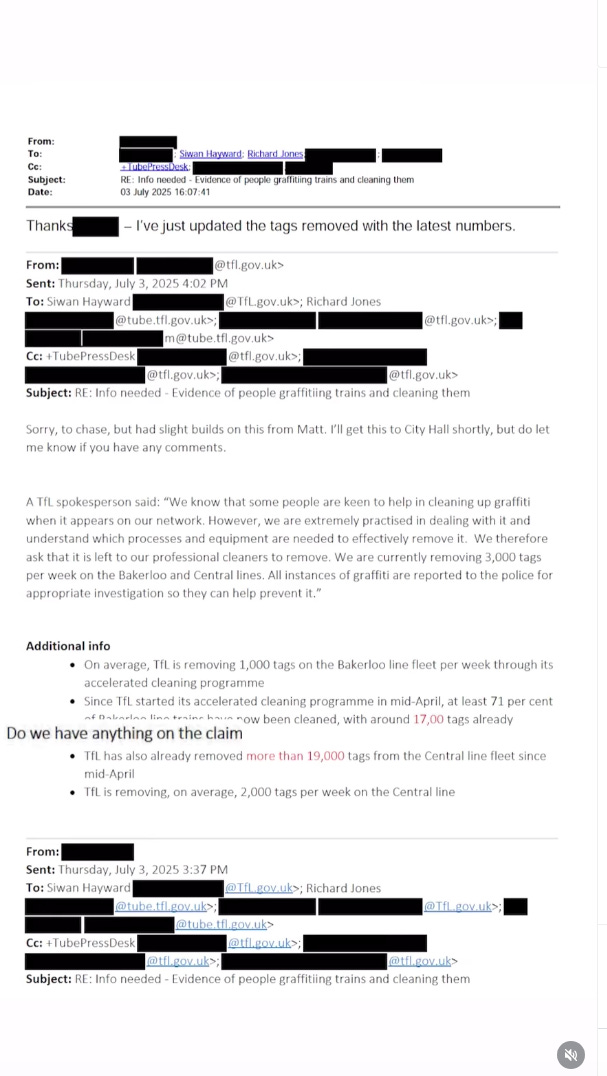
Certainly LFG’s cleaning ‘action’ appears like a stunt, slightly inflated and histrionic, but if it were faked, it would be a rather extravagant effort, and I doubt they wrote their own tags, just saying. Clearly, scepticism abounded as TFL branded LFG’s efforts as a fraudulent enterprise, alleging that they may even have committed a false flag operation by damaging the trains, just to clean them up again, in order to very performatively make a point against TFL and its infrastructure. Matters got out of hand when emails were revealed which appear to show TFL scrambling for an appropriate, let alone normal response, to explain their claims against LFG. If true, the situation is highly embarrassing for TFL
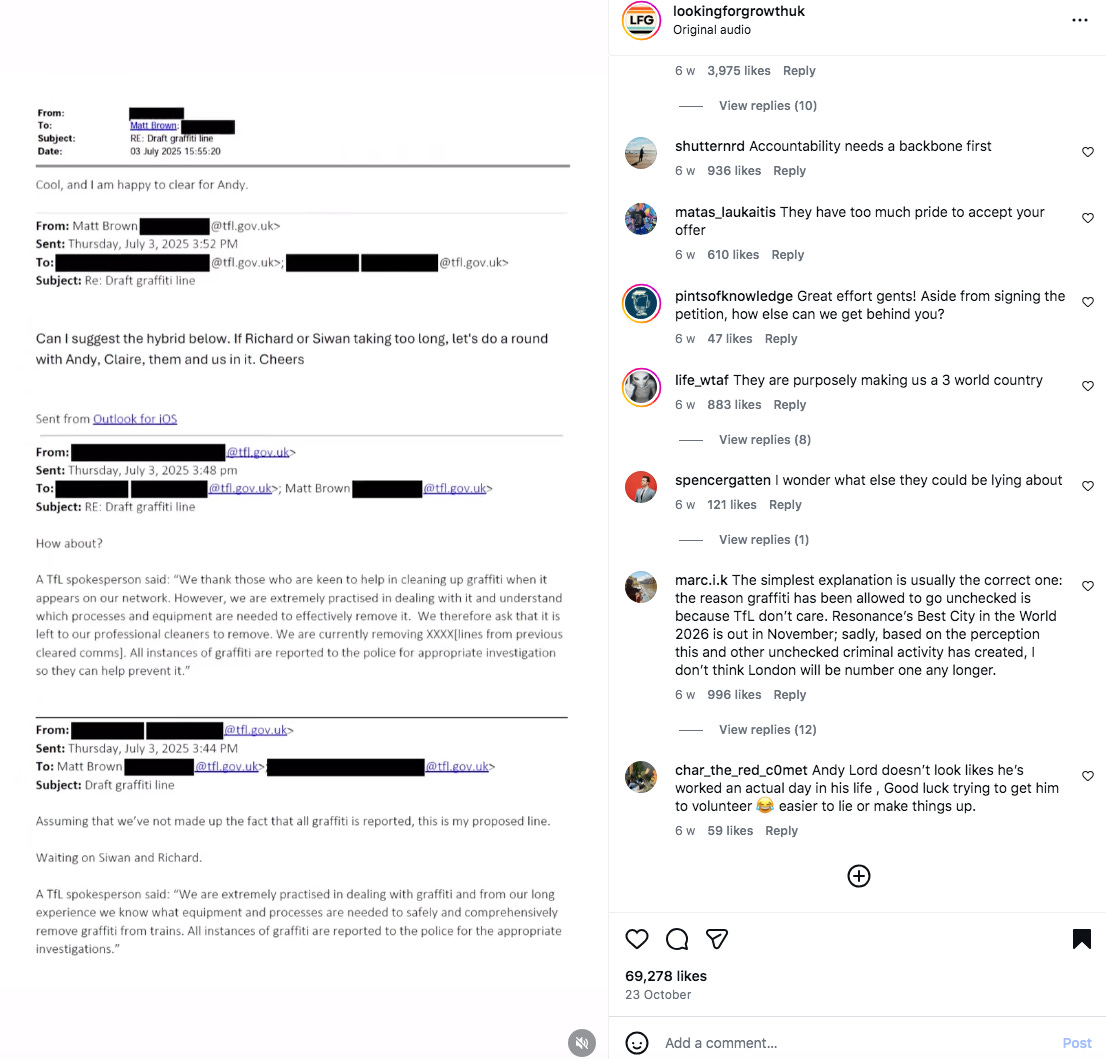
Suitably apoplectic that ‘vexed’ TFL had not taken their earnest, well-meaning work to heart, LFG have since launched their ‘LYING IS NOT OK’ online campaign. With its full caps style of mass communication outrage and Gen-Z sloganeering, LFG presents a somewhat unrealistic demand for a formal apology from TFL: “Say sorry to LFG for lying about our graffiti cleans and branding us as criminals.” along with the demand that Andy Lord, the head of TFL, join them on their next tube clean-up. But LFG do have a point, regardless of what you think of TFL and the level of graffiti on its trains—the situation certainly snowballed out of control towards an untenable position which TFL can’t easily deescalate, or explain away.
WHAT’S SO FUNNY ABOUT PEACE, LOVE AND CASUAL VANDALISM?
Like Carlson and his ilk, LFG lean Right where they see the presence of graffiti as a key performance indicator of yet untold social decline (dope, guns and fucking in the streets etc.). Indeed, it lends itself to the suggestion of a distinctively violent and unwelcoming criminal element, as we have seen with the ‘bad old’ days of New York’s subway in the 1970s, and the ways in which people talk about the rougher ends of London back in the 80s and 90s before we started acknowledging that Gentrification was ‘a thing’. There is a common perception that messy, damaged and certainly graffiti tagged trains create a public perception of being unsafe environments; low-hanging fruit that sparks a slow-burn fear among passengers.
We only have to look back to Kelling and Williams’ notorious ‘broken window theory’ of 1982 which cites examples of damage in public places, such as a broken window or graffiti as directly contributing to ongoing decline and more serious crimes. The presence of damaged street furniture is tacitly accepted by members of the public to reflect the area’s character and provide a further ‘go ahead’ signal of relative lawlessness for criminal elements.

A recent study suggests that there are multiple factors that determine whether or not graffiti in a space adversely affects our mood and our perception of a space. The particular graffiti itself, scale, colour and shapes all play a part; whether it is somehow viewed as being more aggressive, threatening or creative, but also the density and frequency of the writing as palimpsest, layered on top of one another, looking ‘messier’ to the eye. Although the study finds nothing so specific and individualistic as accounting for taste; one person’s Basquiat is another’s Cy Twombly is another’s, Rothko or Picasso etc; there is the further splintering between fine art, street art murals and random acts of graffiti.
So broadly speaking, a fully graffed train in darker hues might be more concerning to people, too moody and ‘edgy’, whereas a few tags here and there would cause less concern. Still, no-one can scientifically account for the feeling of why exactly graffiti on trains is thought to suggest a security risk in itself, the trope of ‘urban’ environments played out in movies and comic books, with an Essex MP complaining that graffiti on his London commute resembles Gotham City—not a real place. Rather graffiti, in its definition as a criminal act, is perceived as a potential trigger of what is permissible or allowed to happen in social environments, towards more extreme behaviours such as violence or abuse to other passengers (as suggested by an Australian-led survey of public transport safety) with more info here on specific anti-graffiti action points.
It is hard to conclude that graffiti on trains could ever be labelled ‘good’, but it is certainly a symptomatic occurrence of marking territory with tags that happens within cities and certainly within the continued flux of major transport systems. But nor is it the great blight of social and moral decay that graffiti is so often scapegoated to be. Today, the trains, tomorrow—Anarchy (in a rush of freewheeling expressionistic colour?) Perhaps, in spite of the good thoughts of Tucker Carlson, The Spectator, LFG et al, this new sodom and gomorrah can’t come soon enough…